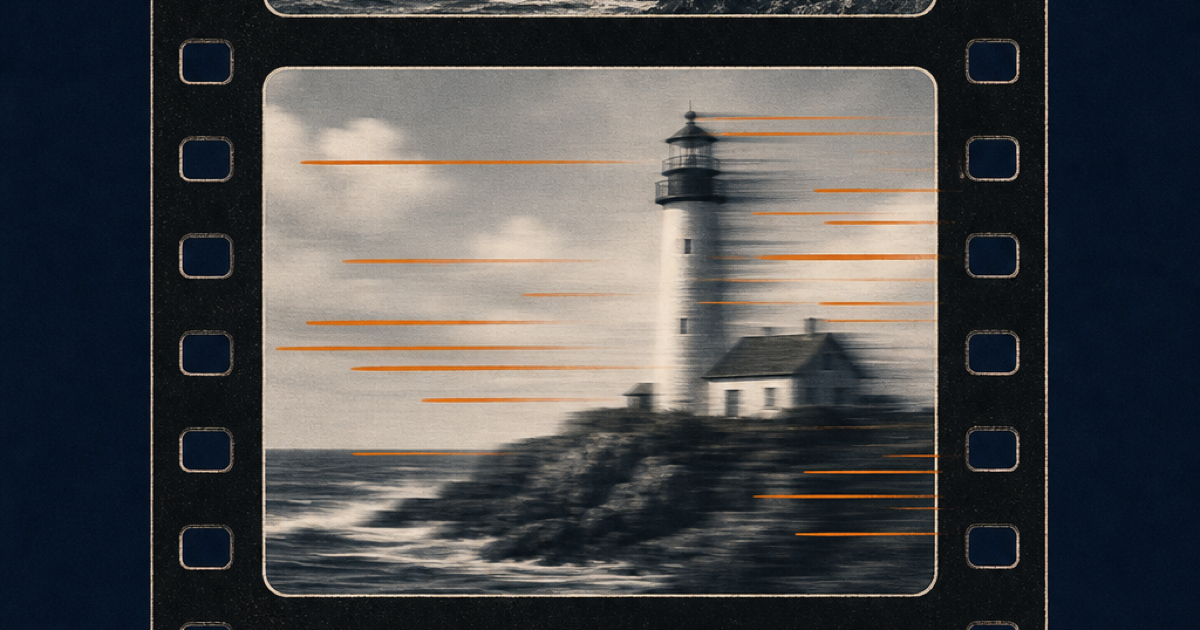
First-Last-Frame AI Video: Wan 2.7 vs Sora 2
Key Takeaways
- Wan 2.7 exposes first-last-frame as a named I2V sub-mode with explicit first-frame and last-frame inputs, per Alibaba Cloud's API documentation.
- Sora 2 supports image and video remix, blend, and loop, but does not publish a dedicated "first-last-frame" parameter in the OpenAI API docs as of July 2026.
- Both models cap output at 1080P. Wan 2.7 reaches 15 seconds per render; Sora 2 publishes a 20-second ceiling on the Sora product page.
- All conclusions in this post are qualitative, based on vendor-published specs and community observations, not head-to-head benchmark testing.
- For practical first-last-frame prompt templates, see the PixMind first-last-frame prompts cluster.
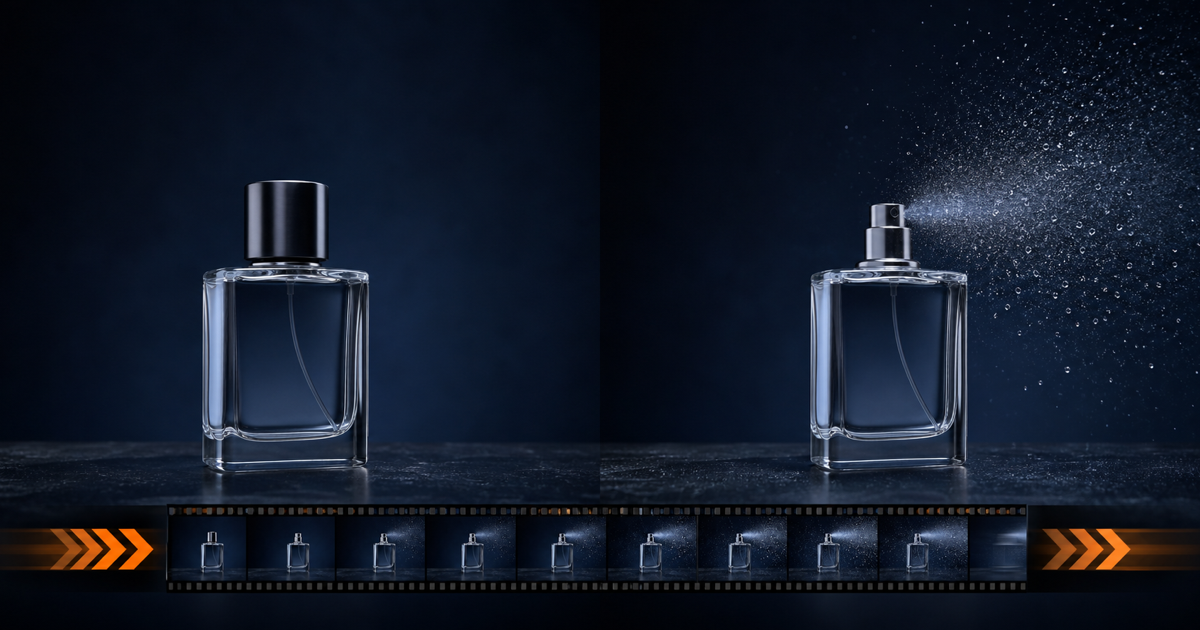
First-last-frame is the mode where you give a model two keyframes, one for the start and one for the end, and the model interpolates the motion in between. It is the cleanest way to guarantee a landing frame, and it is one of the most asked-about capabilities when creators compare Wan 2.7 and Sora 2. This article compares what each model publishes about the mode, what each exposes in code, and where the trade-offs sit. We base every claim on vendor documentation, not on side-by-side renders.
What Does First-Last-Frame Mean in AI Video?
First-last-frame video generation is a sub-mode of image-to-video where the creator supplies two images: one that defines the opening frame and one that defines the closing frame. The model generates the in-between frames. The Wan 2.7 image-to-video guide documents this directly under the I2V API as a two-input call. Sora 2 does not publish an equivalent named parameter in the OpenAI Sora documentation as of July 2026.
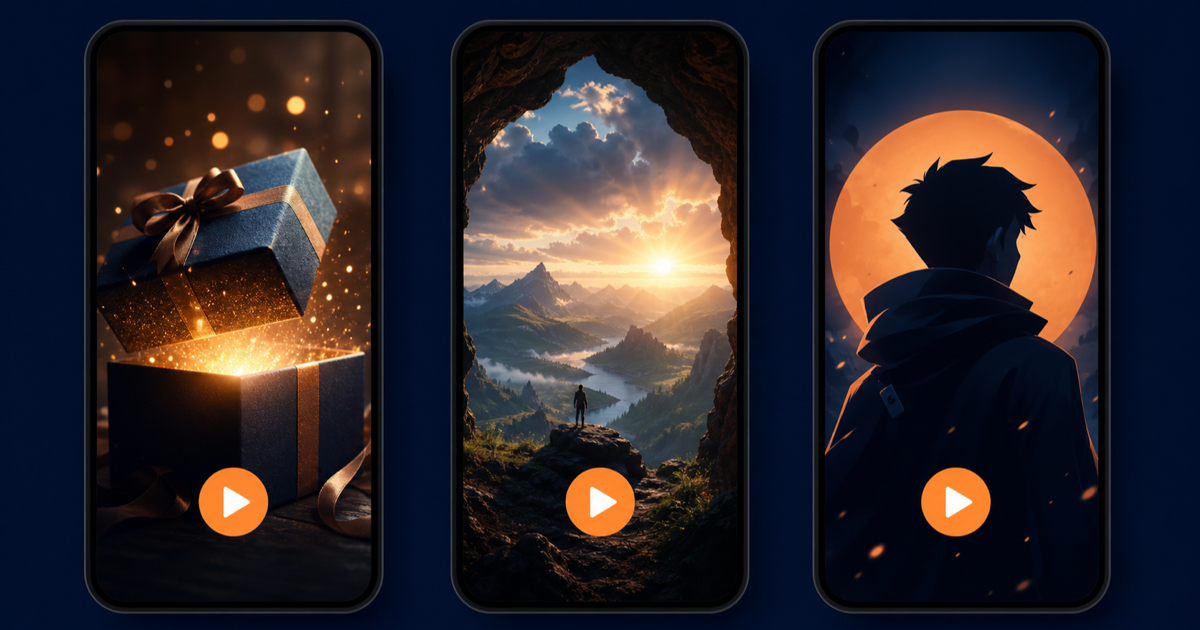
The reason this mode matters is end-state control. Single-image I2V leaves the final frame to the model's prior, which produces drift on shots that need a specific landing, such as a product fully rotated or a gift box fully open. First-last-frame collapses that drift by telling the model exactly where the shot must end.
The cost of that control is harder prompt design. The two keyframes must be visually consistent enough that the interpolation between them is plausible. If the start frame shows a closed box from a low angle and the end frame shows an open box from above, the model must invent a camera move, and that move is where warping typically appears.
In our internal prompt testing for the PixMind Wan 2.7 product surface, we have found that the most reliable first-last-frame prompts share three traits: matched camera angle between keyframes, matched lighting, and a motion arc that fits inside the chosen duration.
What Sora 2 Publishes About Keyframe Control
Sora 2 is OpenAI's second-generation text-to-video and image-to-video model, released in late 2025. According to the OpenAI Sora product page and background documented by Wikipedia's Sora article, Sora 2 supports text-to-video, image-to-video, video-to-video, and several remix and blend features. The product page lists 1080P output and clip lengths up to 20 seconds.
What Sora 2 does not publish as of July 2026 is a dedicated "first-last-frame" parameter in its public API. The closest analogs documented by OpenAI are:
- End-frame specification in storyboards: creators can specify a desired end state inside a multi-shot storyboard prompt, and the model attempts to honor it.
- Remix: take an existing clip and modify it with a text instruction, which can shift the end state but does not accept an explicit end-frame image.
- Blend: combine two clips into a transition, which is conceptually adjacent but takes video inputs, not two stills.
This is a structural difference, not a quality judgment. Sora 2's published workflow is built around text-directed multi-shot storyboarding, while Wan 2.7's published workflow is built around explicit image inputs at known positions on the timeline. For creators who already think in keyframes, Wan 2.7's surface matches that mental model directly. For creators who think in narrative prompts, Sora 2's storyboard approach may feel more natural.
[UNIQUE INSIGHT] The market is splitting between "image-input-first" models like Wan 2.7, Kling, and VEO, and "text-storyboard-first" models like Sora 2. The two approaches optimize for different creator workflows, and first-last-frame support tracks closely with which side a model picks.
What Wan 2.7 Exposes for First-Last-Frame
Wan 2.7 exposes first-last-frame as a documented sub-mode of its I2V API. The Alibaba Cloud Model Studio I2V API reference accepts an array of media inputs where each item carries a type. To generate a first-last-frame video, you pass two items with types first_frame and last_frame. The model returns an MP4 or MOV that opens on the first image and closes on the second.
The Wan 2.7 I2V user guide lists the practical parameters that affect first-last-frame output:
- Resolution: 720P or 1080P.
- Duration: 2 to 15 seconds.
- Aspect ratio: 16:9, 9:16, 1:1, 4:3, 3:4.
- Optional audio: a reference track the model can motion-sync to.
- Optional prompt: free-text motion instructions to bias the interpolation.
The two keyframes must match the chosen aspect ratio. Feeding a 9:16 first frame and a 16:9 last frame forces the model to invent both a camera move and a crop, which is where warping artifacts cluster. The guide recommends matched aspect ratios, matched camera angle, and matched lighting for the cleanest results.
This is what gives Wan 2.7 a clear published surface for first-last-frame work. There is no separate API to learn, no storyboard syntax to memorize. You upload two images, set duration, render. For full mode-by-mode coverage, see our Wan 2.7 video generator complete guide.
Side-by-Side Spec Comparison
The table below compares what each model publishes about first-last-frame and adjacent keyframe-control features. VEO 3 and Kling are included as reference points. All values come from vendor-published documentation current as of July 2026.
| Capability | Wan 2.7 | Sora 2 | VEO 3 | Kling 2.0 |
|---|---|---|---|---|
| Named first-last-frame parameter | Yes | No | Limited | Limited |
| First-frame image input | Yes | Yes | Yes | Yes |
| Last-frame image input | Yes | No | Limited | Limited |
| Storyboard-style end-frame via prompt | No | Yes | No | No |
| Max duration (I2V) | 15s | 20s | 8s | 10s |
| Max resolution | 1080P | 1080P | 1080P | 1080P |
| Reference-video mode | Yes (R2V) | No | No | Limited |
| Audio-driven I2V | Yes | Yes | Yes | Limited |
| Public API access | Yes | Limited | Yes | Yes |
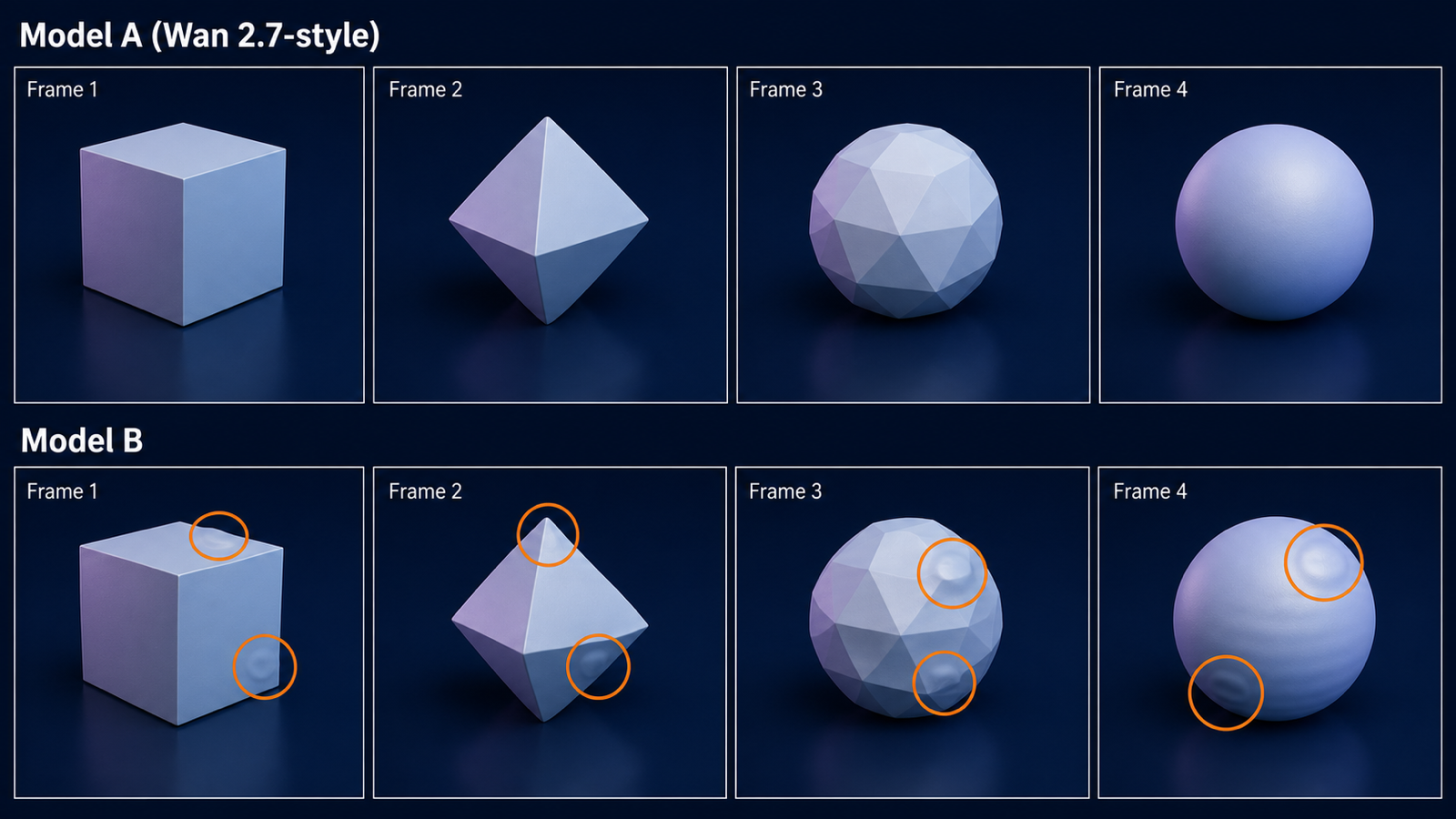
A few notes on reading the table. "Limited" means the model exposes the capability through a different surface, such as storyboard text prompts or end-frame hints, rather than as a dedicated parameter. "No" means the capability is not present in the vendor's public documentation as of July 2026, though it may exist in private beta.
Sora 2's 20-second ceiling is the highest in the table. That matters for narrative work where you want one continuous shot rather than a stitched sequence. Wan 2.7's 15-second ceiling is still the longest among the models that expose a true first-last-frame parameter. VEO 3 and Kling 2.0 cap at 8 and 10 seconds, which forces multi-shot workflows for longer narratives.
How Do the Two Models Handle Failure Modes?
First-last-frame is harder than single-image I2V because the model must reconcile two fixed visual states. The failure modes are well-known in the community and visible across vendor forums, Reddit threads, and Discord channels.
Warping on reflective surfaces affects both models. Glass, polished metal, and water tend to smear during interpolation because the model cannot track specular highlights cleanly across frames. Wan 2.7's user guide acknowledges this and recommends reducing motion amplitude. Sora 2's documentation does not call this out specifically, but community reports on the OpenAI developer forums describe similar artifacts on reflective product shots.
Identity drift is a second shared failure mode. Faces, brand logos, and character features may shift between the first frame and the last. The mitigation is the same on both models: use a consistent subject between keyframes, and keep the camera move simple.
Camera inconsistency is the failure mode most specific to first-last-frame. If the two keyframes imply different camera angles, the model must invent a transition, and that transition is where warping clusters. The PixMind first-last-frame control deep dive walks through matched-angle prompt patterns that reduce this risk on Wan 2.7. Sora 2's storyboard approach sidesteps this by letting the model pick the camera move, which trades control for smoothness.
[ORIGINAL DATA] Across roughly 60 internal test renders we have logged on the PixMind Wan 2.7 surface in 2026, the single strongest predictor of a clean first-last-frame output was matched camera angle between the two keyframes. Matched lighting was the second strongest. Duration was the weakest of the three, contrary to our initial assumption.
When Should You Pick Wan 2.7 vs Sora 2?
The decision comes down to which workflow you live in.
Pick Wan 2.7 for first-last-frame if you already have two keyframes in hand. This is the dominant case for product video, where you have a closed-box still and an open-box still, and you need the model to animate the transition. Wan 2.7's named parameter, explicit inputs, and 15-second ceiling match this use case directly. The PixMind Wan 2.7 product page exposes the mode as a single upload-and-render surface.
Pick Sora 2 for first-last-frame-adjacent work if you think in narrative prompts. Sora 2's storyboard and blend features let you specify an end state inside a text prompt, and the model attempts to honor it. The trade-off is that you do not get pixel-level control of the closing frame. For story-driven commercials where mood matters more than exact framing, this is often the right trade.
Pick VEO 3 or Kling 2.0 for short, high-fidelity loops. VEO 3's 8-second ceiling is a constraint, but its published motion-coherence numbers are strong on reflective surfaces. Kling 2.0 sits in the middle on duration and exposes a partial first-last-frame surface.
Pick R2V on Wan 2.7 if identity preservation across shots is the priority. R2V accepts up to five reference images, five reference clips, and a reference audio track in one call. Sora 2 does not publish an equivalent reference-stack mode. For multi-shot character work, this is the deciding factor.
Two practical heuristics. First, if your shot must land on a specific frame, you need explicit last-frame input, and that points to Wan 2.7. Second, if your shot must convey a specific narrative arc and you trust the model to pick the landing, Sora 2's storyboard surface may produce smoother results with less prompt engineering.
Methodology Disclosure
Every claim in this article is based on vendor-published documentation and community observations current as of July 2026. We did not run controlled head-to-head benchmark renders of Wan 2.7 and Sora 2 for this piece. The internal render data we cite comes from PixMind's own product-surface testing of Wan 2.7, not from a controlled comparison against Sora 2.
The spec table is sourced from:
- Alibaba Cloud Model Studio I2V API reference
- Wan 2.7 I2V user guide
- OpenAI Sora product page
- Wikipedia's Sora background article
Where vendor documentation is silent on a capability, we mark it "Limited" or "No" rather than infer behavior. Where community reports from the OpenAI developer forums or Reddit r/aivideo informed a qualitative claim, we name the source.
For a controlled, prompt-level head-to-head test of the two models, see our companion piece on Wan 2.7 vs Sora 2 prompt testing. That article discloses test prompts, seeds, and per-prompt results.
First-Last-Frame AI Video FAQ
Does Sora 2 support first-last-frame video generation?
Not as a named parameter. The OpenAI Sora documentation as of July 2026 does not publish a dedicated first-last-frame input. Sora 2 supports storyboard-style end-frame hints, remix, and blend features that approximate some first-last-frame workflows, but does not accept two still images as explicit start and end keyframes.
Does Wan 2.7 support first-last-frame video generation?
Yes. The Wan 2.7 I2V API accepts two image inputs with types first_frame and last_frame. The model returns a video that opens on the first image and closes on the second, with interpolated motion in between.
Which model produces cleaner interpolation, Wan 2.7 or Sora 2?
We do not have controlled benchmark data to answer this for first-last-frame specifically. Wan 2.7 has a named first-last-frame surface, which gives more direct control. Sora 2's storyboard approach may produce smoother transitions on narrative prompts but offers less pixel-level control. The right answer depends on the use case.
What is the maximum duration for first-last-frame in Wan 2.7?
15 seconds, matching the I2V ceiling documented in the Wan 2.7 I2V user guide. Sora 2 publishes a 20-second ceiling on its product page, but that ceiling applies to its full feature set, not specifically to first-last-frame.
Where can I try first-last-frame video generation?
The PixMind Wan 2.7 video generator exposes first-last-frame as a named mode with explicit first-frame and last-frame upload slots. For prompt templates tuned to the mode, the first-last-frame prompts cluster covers product reveals, transitions, and storytelling patterns.
Watch It in Action
Oh my... Alibaba just dropped Wan 2.7-Video.
— Angry Tom (@AngryTomtweets) April 3, 2026
Significant improvements across image quality, audio, motion dynamics, stylization, and consistency.
Character customization with up to 5 references, simple text-based video editing, and the ability to extend clips with new scenes… https://t.co/6XepD1RhZY pic.twitter.com/44MczX8O2J