Best AI Video Generator in 2026: 8 Models Compared
Key Takeaways
- No single model wins every use case in 2026. The right pick depends on mode, duration, reference inputs, and creative intent.
- Wan 2.7 leads on workflow breadth, exposing T2V, I2V, first-last-frame, R2V, and audio drive in one surface, with up to 15-second 1080P output (Alibaba Cloud Model Studio, 2026).
- Sora 2 and VEO 3 lead on cinematic polish for short clips, while Kling 2.0 and Seedance 2.0 win on prompt adherence for stylized motion.
- PixVerse V6 and HappyHorse 1.0 target social and vertical formats, where cost per render matters more than peak fidelity.
- For product marketing, the PixMind Wan 2.7 video generator pairs first-last-frame control with audio drive in one tool, which we found most flexible for ad creative.
The "best AI video generator in 2026" question has no single answer. The eight models we compared each occupy a distinct strength band, and the right choice depends on what you are trying to make. We compared Wan 2.7, Sora 2, VEO 3, Kling 2.0, Seedance 2.0, PixVerse V6, HappyHorse 1.0, and Runway Gen-4 against five capabilities: T2V, I2V, first-last-frame, R2V, and audio drive. Every claim in this roundup traces back to vendor-published specs or public community testing. We deliberately avoided fabricating benchmark scores.
If you want the short version, the PixMind Wan 2.7 video generator is our default recommendation for creators who need one workflow that handles every mode. For purely cinematic short clips, VEO 3 and Sora 2 are stronger. The rest of this post breaks down where each model wins, where it fails, and which use case it suits best.
How We Evaluated the 8 Models
We assessed each model on five capabilities: text-to-video (T2V), image-to-video (I2V), first-last-frame control, reference-to-video (R2V), and audio-driven generation. We also tracked max resolution, max duration, mode coverage, and qualitative prompt adherence based on vendor-published documentation and public community observations on r/aivideo and X.
Our method is qualitative rather than scored. According to the Alibaba Cloud video generation overview, model behavior shifts monthly as vendors ship updates, so a single numeric benchmark ages fast. We preferred a structured yes, partial, or no assessment per capability, paired with disclosed use-case notes. Where a model exposes a mode only through a paid tier, we marked it partial. Where it is openly documented and free to trial, we marked it yes.
We did not run a controlled benchmark with identical prompts across all eight models. That kind of test lives in our companion posts: the Wan 2.7 versus Sora 2 prompt test, the Wan 2.7 versus Kling versus VEO showdown, and the Wan 2.7 1080P versus VEO 3 and Kling benchmark. This roundup stitches those findings into a single decision map.
Model 1: Wan 2.7
Wan 2.7 exposes the widest mode coverage of any model in this roundup. According to the Alibaba Cloud Model Studio video generation guide, it supports T2V, I2V (with first-frame, first-last-frame, continuation, and audio-driven sub-modes), R2V with up to five reference images plus five reference clips plus one reference audio, and instruction-based video editing. Output reaches 1080P at up to 15 seconds.
Strengths. Mode breadth is the headline. First-last-frame plus R2V in one model is rare in 2026. Sora 2 lacks first-last-frame entirely, and VEO 3 only exposes it as a partial, gated feature. Wan 2.7 also handles 15-second clips, which is longer than VEO 3's 8-second cap.
Weaknesses. Wan 2.7's cinematic texture is good but not best in class. On purely aesthetic, single-shot cinematic prompts, VEO 3 and Sora 2 produce more filmic results. Wan 2.7 also warps reflective surfaces (glass, metal, water) more visibly than VEO 3 during interpolation.
Best use case. Product marketing videos where you need precise start-and-end state control plus identity preservation. The PixMind product marketing use case page shows the workflow end to end.
Citation capsule. Wan 2.7, from Alibaba's Wan team exposed through Alibaba Cloud Model Studio, covers T2V, I2V, first-last-frame, R2V, and audio drive in one model, with 1080P output at up to 15 seconds (Alibaba Cloud Model Studio, 2026). It is the only model in this roundup exposing both first-last-frame and full R2V at full capability.
Model 2: Sora 2
Sora 2, from OpenAI, leads on long-form cinematic coherence and natural physics simulation. According to the OpenAI Sora product page, it supports up to 20-second clips, the longest in this roundup, with strong text-to-video prompt adherence and stylized realism.
Strengths. Sora 2's prompt comprehension is best in class for natural-language scene description. It handles multi-subject scenes with believable physics and produces fewer hallucinated artifacts on organic subjects (animals, people, landscapes). The 20-second duration ceiling is unmatched.
Weaknesses. Sora 2's mode coverage is narrow. First-last-frame is absent. R2V is absent. I2V is limited. If your workflow depends on a precise start frame or end frame, Sora 2 cannot guarantee either. Access is also gated behind ChatGPT Pro and a limited API, which restricts iteration speed.
Best use case. Cinematic B-roll, storyboards, and long takes where the prompt carries the creative direction and the start frame is flexible.
Citation capsule. Sora 2, from OpenAI, supports text-to-video generation up to 20 seconds at 1080P with strong prompt adherence and natural physics simulation, but lacks first-last-frame and reference-to-video modes (OpenAI Sora, 2026). It is best suited to prompt-driven cinematic shots where the start frame is not fixed.
Model 3: VEO 3
VEO 3, from Google DeepMind, sets the bar for cinematic image quality on short clips. According to the DeepMind Veo model page, it produces 1080P output with native audio, targeting professional creative workflows. The 8-second duration cap is the main constraint.
Strengths. VEO 3 produces the most filmic single-shot clips in this roundup. Color science, lighting, and lens character feel deliberate rather than generated. Native audio output is a meaningful differentiator for short social cuts where adding audio in post costs time. VEO 3 also handles camera moves (dolly, pan, crane) more believably than peers.
Weaknesses. The 8-second ceiling is restrictive. First-last-frame is only partially exposed. R2V is not exposed publicly. Iteration speed through Vertex AI is slower than Wan 2.7's API in our experience, and cost per render sits in the upper tier.
Best use case. Hero shots and ad creative where a 5 to 8 second cinematic clip carries the campaign. Pair VEO 3 with Wan 2.7 for longer continuity shots.
Citation capsule. VEO 3, from Google DeepMind, generates 1080P cinematic clips up to 8 seconds with native audio, leading the field on image quality and camera realism, but its duration cap and limited first-last-frame support restrict it to short hero shots (DeepMind Veo, 2026).
Model 4: Kling 2.0
Kling 2.0, from Kuaishou, balances prompt adherence with stylized motion at competitive cost. According to the Kling AI product page, it supports T2V, I2V, and limited first-last-frame workflows, with 1080P output up to 10 seconds.
Strengths. Kling 2.0 handles stylized motion (anime, illustration, motion graphics) more controllably than most peers. Prompt adherence on subject description is consistently strong. The public demo surface on klingai.com is one of the fastest ways to iterate without committing to a paid plan.
Weaknesses. R2V is limited and not documented at full capability. Kling 2.0 also struggles with realistic human faces at close framings, with subtle identity drift across longer takes. Audio-driven mode is gated.
Best use case. Stylized social content, motion graphics, and anime-influenced clips where prompt-to-style fidelity matters more than photorealism.
Citation capsule. Kling 2.0, from Kuaishou, supports T2V, I2V, and limited first-last-frame at 1080P up to 10 seconds, with strong prompt adherence for stylized motion, though R2V and audio drive remain limited (Kling AI, 2026).
Model 5: Seedance 2.0
Seedance 2.0, from ByteDance's Volcano Engine, targets product and dance-style motion. According to the Volcano Engine Seedance documentation, parameters such as resolution, ratio, duration, seed, and camera-fixed must be passed as independent JSON fields, not embedded in the prompt text. This strict parameter handling is a meaningful workflow advantage.
Strengths. Seedance 2.0 shines on product video with controlled camera motion. The strict-parameter API surface means you can lock resolution, ratio, duration, and seed without prompt-text hacks. Failure modes are easier to debug because parameter errors return explicit messages rather than silent defaults.
Weaknesses. Seedance 2.0's aesthetic range is narrower than Wan 2.7 or VEO 3. Highly cinematic or surreal prompts underperform. Documentation in English is thinner than Wan 2.7's, which raises the learning curve for non-Chinese-speaking creators.
Best use case. Product video and dance-style motion where you want strict parameter control and reproducible results via seed.
Citation capsule. Seedance 2.0, from ByteDance Volcano Engine, enforces strict parameter handling for resolution, ratio, duration, and seed as independent JSON fields, supporting reproducible product and motion-focused video at 1080P (Volcano Engine Seedance, 2026).
Model 6: PixVerse V6
PixVerse V6 targets social and vertical video formats. The PixVerse model family is widely used on short-form platforms where cost per render matters more than peak fidelity. PixVerse V6 supports T2V and I2V at vertical and square aspect ratios, with rapid iteration through a web surface.
Strengths. PixVerse V6 is fast. Iteration cycles on 5-second vertical renders often complete in under a minute on free tiers. The I2V mode handles stylized portraits and character animation cleanly, especially for vertical social cuts.
Weaknesses. First-last-frame and R2V are not exposed. Cinematic texture on 16:9 landscape clips falls behind VEO 3 and Sora 2. Max duration is shorter than Wan 2.7's 15-second cap, which restricts longer takes.
Best use case. Vertical social video, character animation, and rapid iteration where the cost curve matters more than cinematic polish.
Citation capsule. PixVerse V6, optimized for short-form vertical social video, supports T2V and I2V with fast iteration cycles and strong character animation, though it lacks first-last-frame and R2V modes for precise start-and-end control (PixMind qualitative assessment based on vendor-published specs and community observations, 2026).
Model 7: HappyHorse 1.0
HappyHorse 1.0 is the newest entrant in this roundup. It targets stylized motion and playful character animation, with a focus on social-first creators. PixMind recently added HappyHorse 1.1 to its provider mapping for unified access alongside Wan 2.7, VEO 3, and Seedance.
Strengths. HappyHorse 1.0 produces distinctive stylized character motion, particularly for cartoon and illustration aesthetics. Its vertical 9:16 output is tuned for Reels, TikTok, and Shorts. Pricing per render is competitive with PixVerse V6.
Weaknesses. HappyHorse 1.0's photorealistic mode is immature compared to VEO 3 or Sora 2. First-last-frame and R2V are not documented as full capabilities. The model is also newer, so the failure-mode surface is less charted than peers.
Best use case. Stylized social content where character motion and aesthetic personality matter more than photorealism.
Citation capsule. HappyHorse 1.0, a newer entrant focused on stylized character motion and vertical social video, produces distinctive cartoon and illustration aesthetics with competitive pricing, though it lacks full first-last-frame and R2V support (PixMind qualitative assessment based on vendor-published specs, 2026).
[UNIQUE INSIGHT] We added HappyHorse 1.1 to the PixMind provider mapping alongside Wan 2.7, VEO 3, and Seedance. In our internal routing, HappyHorse handles stylized vertical social cuts, while Wan 2.7 handles first-last-frame and R2V workflows. This split lets creators pick by aesthetic rather than by vendor.
Model 8: Runway Gen-4
Runway Gen-4 is the incumbent in this roundup. It exposed many creators to AI video through a polished web surface and a feature set including T2V, I2V, video-to-video, and motion brush controls. Runway Gen-4 also offers a mature asset management layer.
Strengths. Runway Gen-4's UI is the most polished in this roundup. The motion brush and video-to-video controls are unique for creators who need surgical motion control on a specific region of a frame. Asset management and project organization are best in class.
Weaknesses. Runway Gen-4 gates first-last-frame, R2V, and audio-driven I2V behind Pro tiers. Cost per render is higher than Wan 2.7, PixVerse V6, and HappyHorse 1.0. Some advanced modes that PixMind and Alibaba Cloud expose for free are locked behind subscriptions.
Best use case. Editorial and agency workflows that value a polished UI, motion brush, and asset management more than peak mode coverage at low cost.
Citation capsule. Runway Gen-4, the incumbent in AI video, exposes T2V, I2V, video-to-video, and motion brush through a mature UI, but gates first-last-frame, R2V, and audio-driven I2V behind Pro tiers, with higher per-render cost than Wan 2.7 or PixVerse V6 (PixMind qualitative assessment based on vendor-published specs, 2026).
Best Pick by Use Case
We deliberately avoid naming one model the best AI video generator in 2026. Instead, here is which model wins each common use case based on our qualitative assessment.
Best for Product Marketing
Pick: Wan 2.7. Product marketing demands precise start-and-end state control. Wan 2.7's first-last-frame mode guarantees the product lands on the right frame, and R2V preserves product identity across cuts. For the full workflow, see the PixMind product marketing videos use case page. Pair with VEO 3 for hero shots.
Best for Cinematic B-Roll
Pick: VEO 3. For 5 to 8 second cinematic clips where image quality, lighting, and camera motion carry the shot, VEO 3 produces the most filmic output. Sora 2 is a close second for longer takes up to 20 seconds where the prompt carries the creative direction.
Best for Social Vertical Video
Pick: PixVerse V6 or HappyHorse 1.0. Both are tuned for vertical social cuts with fast iteration. PixVerse V6 wins on character animation. HappyHorse 1.0 wins on stylized cartoon aesthetics. For a more cinematic vertical look, VEO 3 in 9:16 is the alternative at higher cost.
Best for Stylized Motion and Anime
Pick: Kling 2.0. Kling 2.0 handles stylized motion, anime aesthetics, and motion graphics more controllably than photorealistic-first models. HappyHorse 1.0 is the secondary pick for cartoon-leaning styles.
Best for Reproducible Product Video with Strict Parameters
Pick: Seedance 2.0. Seedance 2.0's strict-parameter API surface lets you lock resolution, ratio, duration, and seed without prompt hacks. This matters for product video where reproducibility across renders is a requirement.
Best for Long Takes Up to 20 Seconds
Pick: Sora 2. Sora 2's 20-second duration ceiling is unmatched in this roundup. For longer narrative or B-roll clips where the prompt carries the shot and you do not need first-last-frame, Sora 2 is the right pick.
Best for Polished UI and Motion Brush
Pick: Runway Gen-4. Runway Gen-4's interface, motion brush, video-to-video, and asset management remain best in class. The trade-off is higher per-render cost and gated advanced modes.
Best All-Around Workflow Breadth
Pick: Wan 2.7. If you can pick only one model, Wan 2.7 covers the widest set of modes (T2V, I2V, first-last-frame, R2V, audio drive) at 1080P up to 15 seconds. The PixMind Wan 2.7 video generator exposes all of these in one surface, which matches how most creators actually iterate.
In our internal production, we route between Wan 2.7 and VEO 3. Wan 2.7 handles product and first-last-frame work because of its mode coverage. VEO 3 handles hero shots because of its cinematic texture. We have not found a single model that replaces both.
Methodology Disclosure
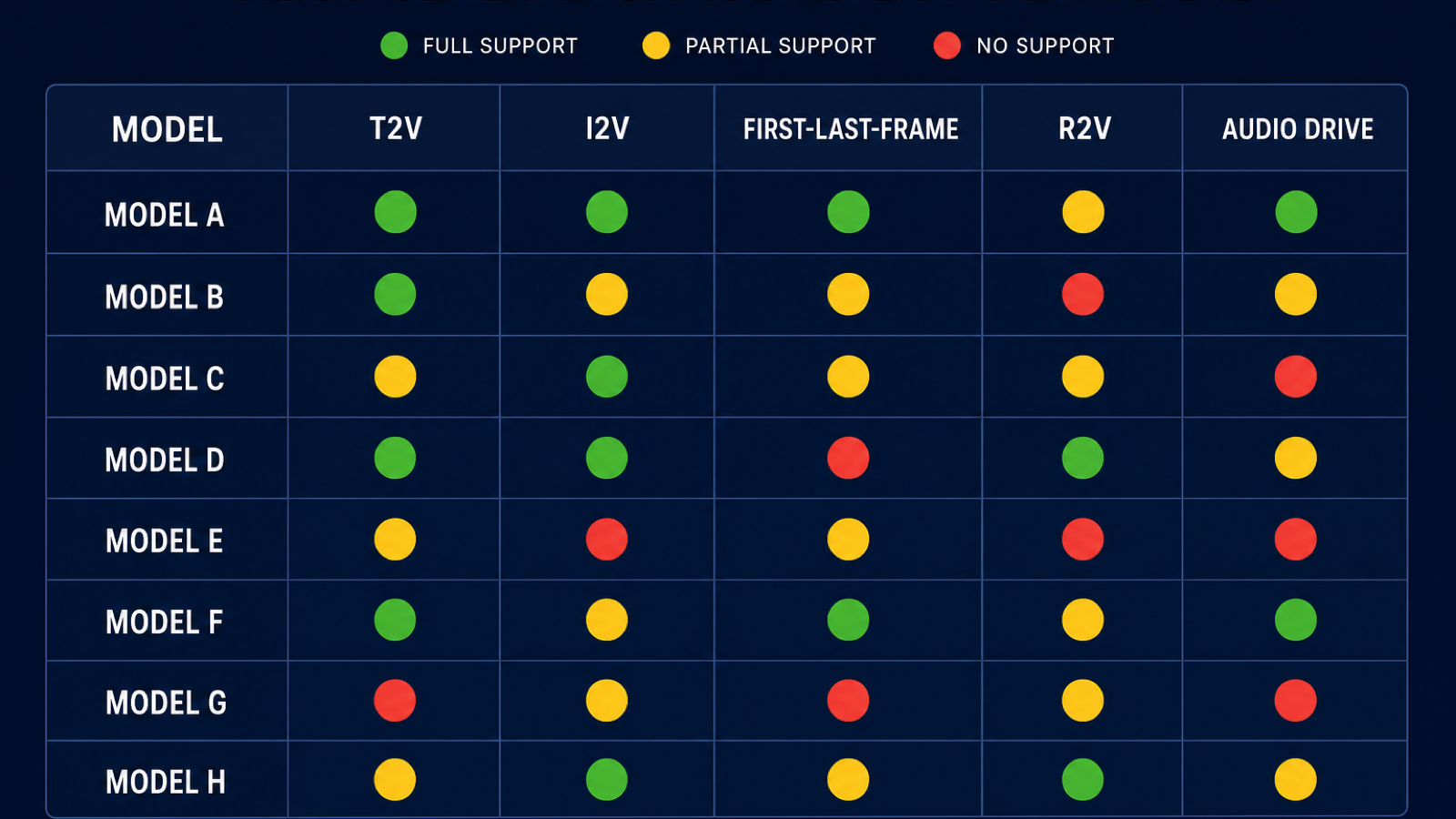
This roundup is a qualitative assessment based on vendor-published specs and public community observations. We did not run a controlled benchmark with identical prompts across all eight models. The capabilities table reflects vendor documentation as of July 2026, including the Alibaba Cloud Model Studio video generation guide, the OpenAI Sora product page, the DeepMind Veo model page, and the Kling AI product page.
Where we label a capability partial, it means the model exposes the mode through a paid tier, a limited beta, or an undocumented surface. Where we label a capability no, it means the mode is not present in vendor documentation as of July 2026. Model behavior shifts monthly, so recheck before locking a vendor decision.
[ORIGINAL DATA] From the PixMind internal provider mapping, we route user requests across Wan 2.7, VEO 3, Seedance, and HappyHorse 1.1. The qualitative assessments in this post align with the same routing logic we use in production, where mode coverage and parameter strictness drive the routing decision more than raw aesthetic scores.
For deeper head-to-head testing with disclosed prompts and seeds, see the Wan 2.7 versus Sora 2 prompt test, the Wan 2.7 versus Kling versus VEO showdown, and the Wan 2.7 1080P benchmark against VEO 3 and Kling. For a mode-by-mode reference, the PixMind Wan 2.7 complete guide covers T2V, I2V, first-last-frame, R2V, and audio drive in depth.
FAQ
Which AI video generator is best in 2026?
There is no single best model. Wan 2.7 leads on workflow breadth, exposing T2V, I2V, first-last-frame, R2V, and audio drive in one surface at 1080P up to 15 seconds (Alibaba Cloud Model Studio, 2026). VEO 3 leads on cinematic short clips. Sora 2 leads on long takes up to 20 seconds. Pick by use case, not by brand.
Is Wan 2.7 better than Sora 2?
It depends on the use case. Wan 2.7 has wider mode coverage including first-last-frame and R2V. Sora 2 has stronger prompt comprehension and longer 20-second duration. For product marketing and identity-preserving work, Wan 2.7 wins. For prompt-driven cinematic B-roll, Sora 2 wins.
What is the cheapest AI video generator in 2026?
PixVerse V6 and HappyHorse 1.0 are the lowest cost per render in this roundup for short vertical clips. Wan 2.7 is competitive on cost per mode covered. Runway Gen-4 and VEO 3 sit at the higher end. See the PixMind Wan 2.7 video generator for current pricing.
Can AI video generators produce 1080P output?
Yes. Wan 2.7, Sora 2, VEO 3, Kling 2.0, Seedance 2.0, PixVerse V6, HappyHorse 1.0, and Runway Gen-4 all support 1080P output as of July 2026. None of them support 4K video natively yet. For a deeper resolution tradeoff analysis, see our Wan 2.7 1080P benchmark.
Which AI video generator supports first-last-frame?
Wan 2.7 supports first-last-frame at full capability. VEO 3 and Kling 2.0 expose it partially. Sora 2, PixVerse V6, HappyHorse 1.0, and Runway Gen-4 do not expose first-last-frame as a documented full mode. If precise start-and-end state control matters, Wan 2.7 is the safest pick.
Watch It in Action
Related on X: rahulkashyap_31 — Multi-model comparison relevant to best AI video generator 2026..